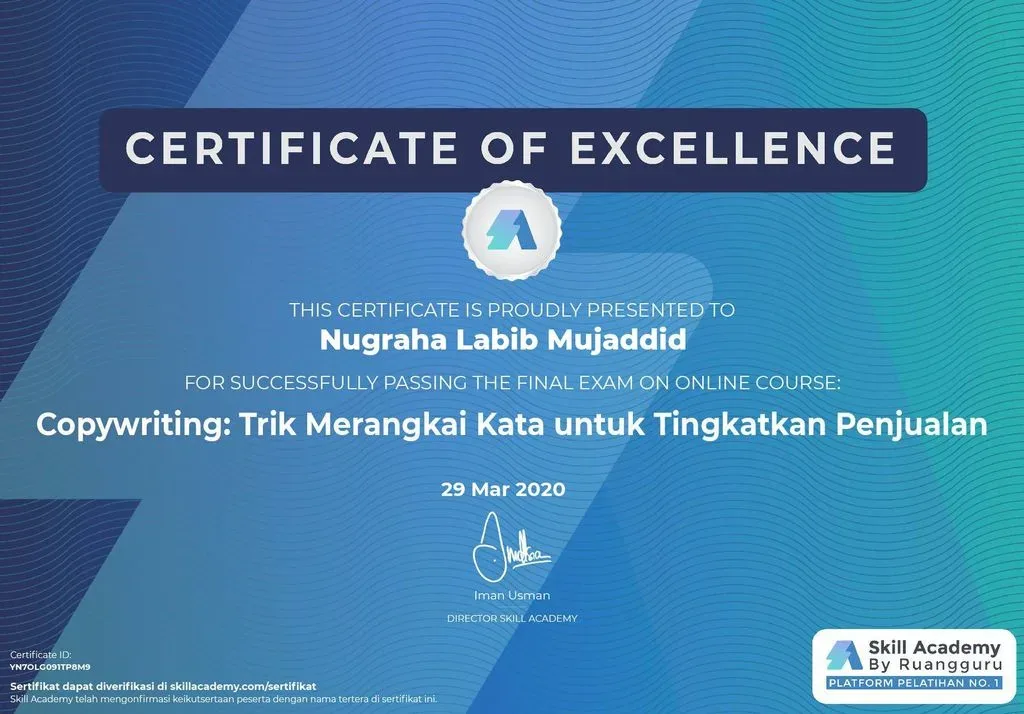
Technical products are easy to describe and hard to sell. The specification sheet is right there, complete and accurate, and almost nobody buys because of it. Most of what I know about closing that gap comes from one decision in March 2020, more than a year and a half before I posted my first video: I took the certified course Copywriting: Crafting Words to Boost Sales at Skill Academy by Ruangguru. It turned out to be the turning point before the content career. What follows are six principles from that training that I still use, each with a before-and-after line. The example copy is invented; the principles are not.
The turning point
In March 2020 I was an architecture student just finishing a junior architect internship, producing renders for client presentations, and I could explain a building in detail without ever explaining why anyone should want it. The course taught four things I had not been taught anywhere else: how to simplify technical specifications into benefits, how to model the psychology of the audience you are writing for, how to structure a story so that it carries a message, and how to sell softly enough that people do not feel sold to. Everything below is one of those four, made concrete.
Specs are not benefits
Principle 1: translate every specification into what the reader gets to do, feel or stop worrying about. The spec stays as proof, one clause later.
- Before: 5,000 mAh battery with 65 W fast charging.
- After: Leave the charger at home. A full day on one charge, and ten minutes at the wall buys you the evening (5,000 mAh, 65 W).
Principle 2: one idea per line. A sentence with two benefits is a sentence with none, because the reader has to choose which one to believe.
- Before: Lightweight, powerful, with a long-lasting battery and a stunning display for work and play.
- After: Light enough to forget it is in the bag.
Write for how people actually decide
Principle 3: name the objection before the reader does. People do not read copy to be convinced; they read it looking for the reason to say no. Say the reason first, calmly, and you keep them.
- Before: Premium build quality at an affordable price.
- After: Yes, it is the cheaper model. Here is exactly what you give up, and what you do not.
Principle 4: anchor to the reader's own comparison, not yours. Audiences carry a mental model built from what they already own. Copy that anchors to that model is understood in one read; copy that anchors to a competitor's spec sheet has to be translated first.
- Before: 120 Hz adaptive refresh rate display.
- After: Scrolling feels the way your old phone felt the day you bought it, and stays that way.
Story before sale
Principle 5: put the product inside a moment, then let the reader finish the story. A specification describes an object; a story describes a change in someone's day. The structure I use is small: a situation the reader recognises, a friction, the product as the thing that removes the friction, and a last line that leaves the ending to them.
- Before: Noise-cancelling headphones with 30-hour battery life.
- After: The office is loud again. You put them on, and the argument two desks away turns into weather. Thirty hours later you remember to charge them.
Soft-selling that still converts
Principle 6: ask for the smallest next step, and make it feel like the reader's idea. Hard calls to action work when the reader has already decided. For a technical product most readers have not; they need one more piece of certainty, not a push. So the ask should be an invitation to check, compare or try, phrased in their interest.
- Before: Buy now, limited stock, do not miss out.
- After: If you want to see whether it fits your setup, the full spec sheet is one tap away.
This is the principle that carried most directly into affiliate work later. The videos that converted best were the ones that let the viewer feel they had checked the product themselves.
A checklist before you publish
Before any technical copy goes out, I run it against six questions that map to the principles above.
- Is every specification paired with a benefit the reader can picture?
- Does each sentence carry one idea?
- Have I named the biggest objection in the first third?
- Am I anchoring to what the reader already knows?
- Is there a moment, not just an object?
- Is the ask sized to how sure the reader is right now?
If a line fails one of these, I rewrite the line, not the argument. The principles are simple, and that is why they hold.
Where to go next: if you are launching a technical product and want the copy to carry its weight, get in touch.
Questions people ask
- In March 2020 he completed the certified course Copywriting: Crafting Words to Boost Sales at Skill Academy by Ruangguru.
- Translate every specification into what the reader gets to do, feel or stop worrying about, and keep the specification as proof one clause later.