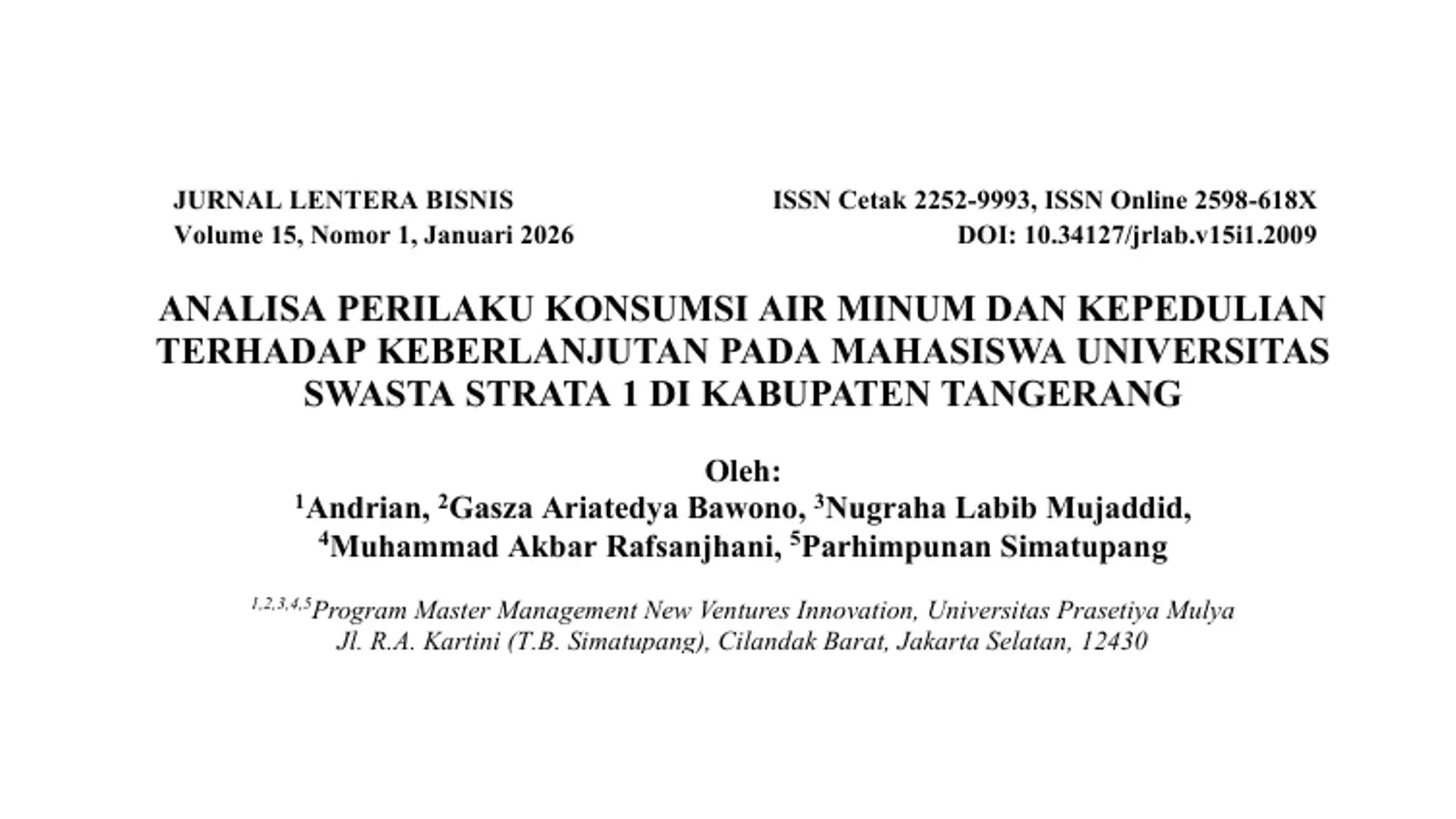
The question
Single-use bottled water stays popular on campus even as the health risks of microplastics become better known. We wanted to know what actually drives a student to buy another bottle: what they know, how convenient it is, whether they trust the alternatives, what their friends do, or whether a refill station is within reach.
The model combines the Theory of Planned Behavior with the Knowledge, Attitude and Practices model, and tests five factors against drinking-water consumption behaviour.
How we measured it
- 183 respondents: active undergraduates at private universities in Tangerang who drink water on campus, chosen by purposive sampling.
- An online questionnaire on a five-point Likert scale.
- Structural equation modelling (SEM-PLS) in SmartPLS, after validity and reliability tests.
What we found
183
respondents
0.6
R², behaviour explained by the five factors
4 of 5
factors with a significant effect
| Factor | Direction | p | T | Result |
|---|---|---|---|---|
| Environmental and health knowledge | Negative | 0.004 | 2.888 | Significant |
| Convenience | Positive | 0.008 | 2.650 | Significant |
| Risk perception of other water sources | Positive | 0.037 | 2.089 | Significant |
| Social norms | Positive | 0.084 | 1.729 | Not significant |
| Behavioural control (refill stations, own bottle) | Negative | 0.033 | 2.135 | Significant |
Students who know more about the health and environmental cost buy less bottled water, and a reachable refill station lowers consumption as well. Convenience and doubts about the safety of other water sources push the other way. What friends do made no significant difference: the decision turned out to be a rational one, not a social one.
What campuses can do
- Put the facts where the water is: health education about microplastics at the refill machines themselves.
- More refill points, so a station is always closer than a vending machine.
- Machines that compete on convenience: fast and easy to use, with water-quality readings such as TDS and pH shown in real time.
Limits
The study is cross-sectional, covers private universities only and relies on self-reported behaviour, and 41 percent of the variation is left to other factors. A field experiment with refill stations and a look at price sensitivity are the natural next steps.
Read the paper
Questions people ask
- Yes. He co-authored a paper on students' drinking-water behaviour and sustainability in Jurnal Lentera Bisnis (SINTA 4) in January 2026, written during his Master of Management in New Ventures Innovation at Universitas Prasetiya Mulya.
- Convenience and risk perception push students towards bottled water; environmental knowledge and refill stations reduce it; social norms made no significant difference.